
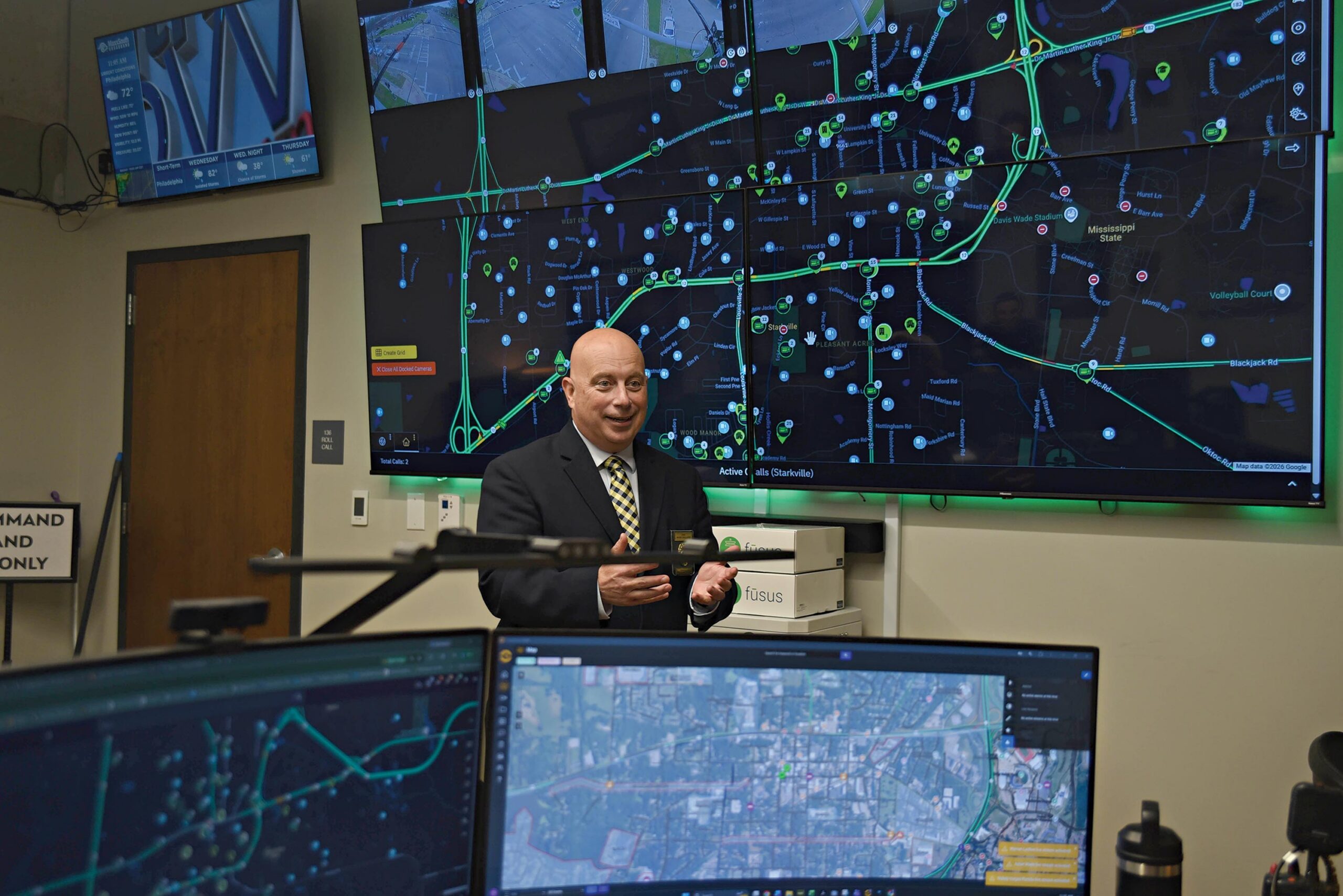
Lee Upchurch, an intelligence analyst with the Starkville Police Department, can usually be found at his desk in a dimly lit room at the back of the station. On the wall beside him is a bank of four larger screens displaying a map of Starkville dotted with camera icons.
Each camera represents a home or business participating in Connect Starkville, a public safety program that allows residents to assist police by sharing footage from their security systems. When a crime occurs, Upchurch quickly identifies which cameras are nearby and sends alerts requesting footage.
“It’s immediate, which means we get the information back quicker, which means we get the vehicle quicker, which means we solve the crime,” Upchurch said.
The program, launched in 2021, grew out of Chief Mark Ballard’s push for “21st-century policing,” a push that involves embracing technology, he said.
SPD developed the system after visiting real-time crime centers in New York, New Orleans and Oxford, and seeing firsthand how cameras worked together to streamline investigations. Gone were the days of officers spending hours walking streets, looking for cameras and knocking on doors – a labor-intensive process often reserved for the most serious crimes, Ballard said.
“The community connect program allowed us to knock out all those checkpoints to not just save candidacy for the most egregious crimes, but for crimes like property crimes (and) autoburglaries,” Ballard said. “… The ability to be able to connect with people … to ensure that … safety is a shared responsibility, bridging the trust there with us, with the camera systems, … allows us to be very fast, I would say.”
Since its launch, Connect Starkville has grown to include 853 registered residential cameras and 807 integrated business cameras, numbers that continue to rise.
Registered cameras simply give police knowledge of camera locations, and residents can choose whether to share footage when requested.
Integrated cameras, often located outside of businesses, schools and churches, allow voluntary live-feed access to high-traffic areas. SPD cannot tap live feeds from any residential cameras.
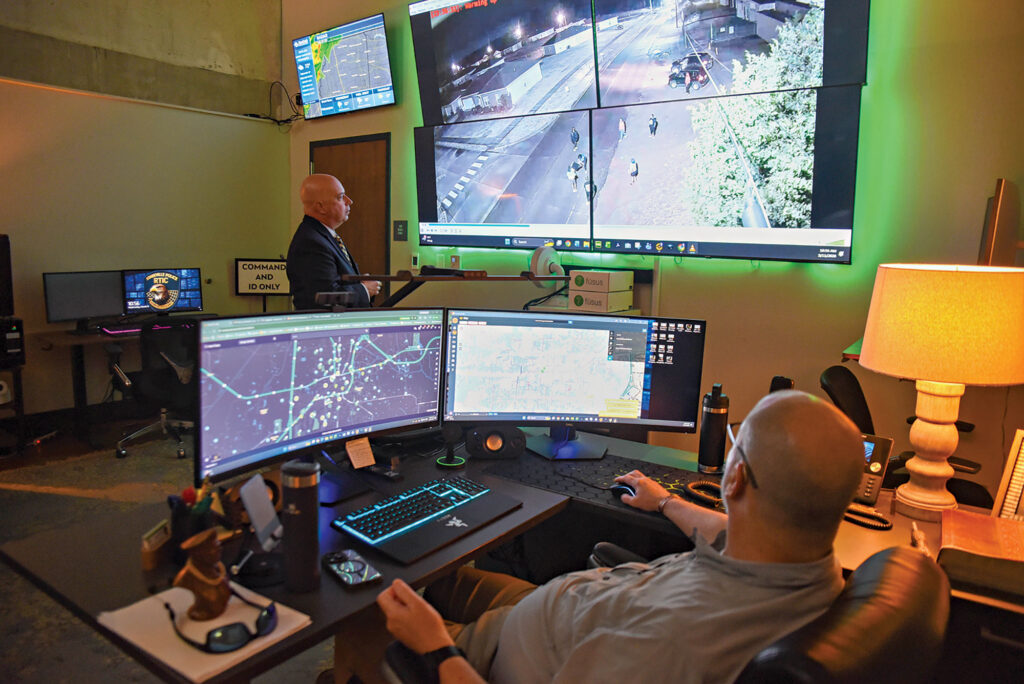
Ballard said the system has played a key role in solving “numerous” crimes.
One 2022 case involved a shooting on Orchard Lane near Reed Road. Footage from a nearby camera showed a group of minors and young adults fighting in the street. One man sneaked around a car with an AR-15, firing about 11 rounds before the group dispersed.
Only one 911 call came from a quarter mile away.
“No one (in the area) called,” Ballard said. “… You just thought when people are around where a crime is going to take place, people will call. … Well what did the camera show? What really happened.”
Another video captured a woman being shoved into a car outside of a gas station. Though bystanders looked concerned, only one 911 call was made. Police used the footage to track the vehicle to a motel in a nearby city, where officers and a SWAT team rescued her.
“I truly believe we saved a life,” Ballard said.
Cameras also help officers verify events and protect against false allegations, particularly during jury trials. Witnesses may refuse to cooperate, fall ill or be impaired, Ballard said, while cameras provide consistent evidence.
“(A camera) doesn’t get scared,” he said. “It doesn’t get emotional. It’s going to record. … At the end of the day, a criminal still has to walk, ride a bike or a car to commit a crime … and chances are, they’re doing it in front of someone’s camera.”
Ballard said the system’s effectiveness grows as more cameras join the registry. Residents and businesses interested in registering or integrating their outdoor cameras can visit the Connect Starkville website.
Story by Cadence Harvey
Photos by Deanna Robinson