
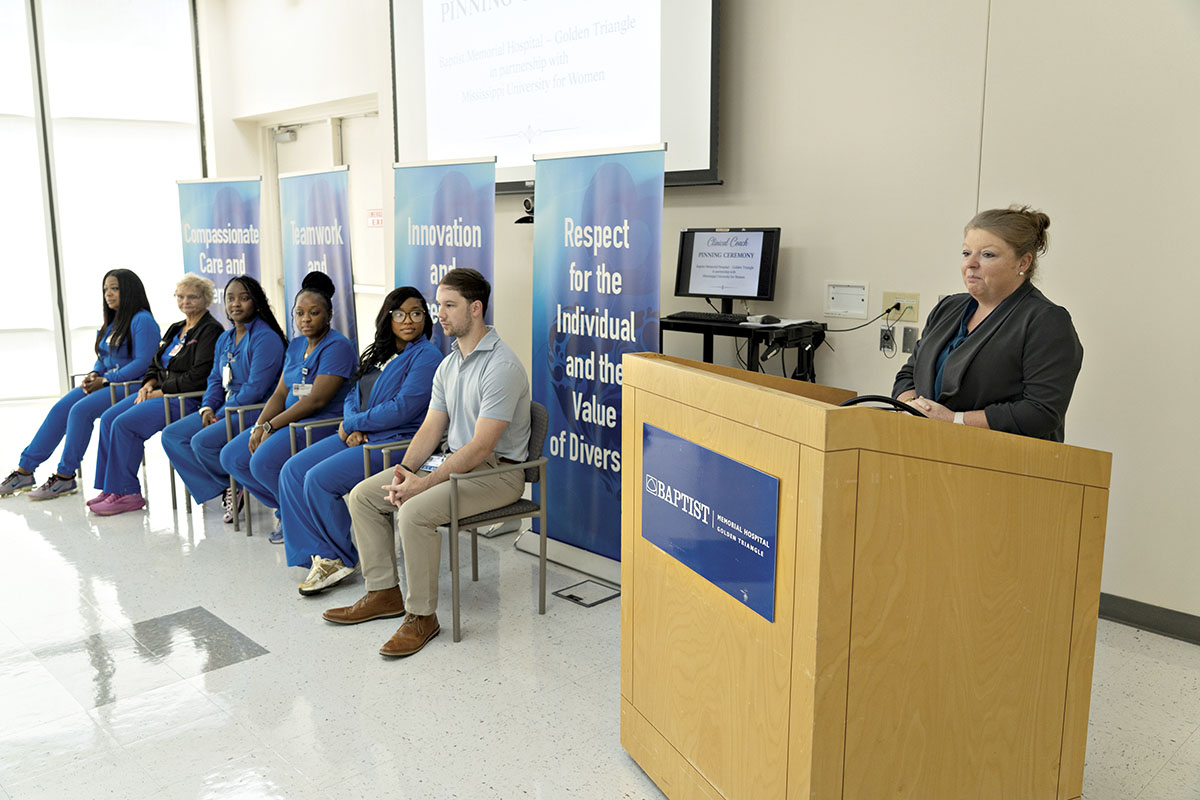
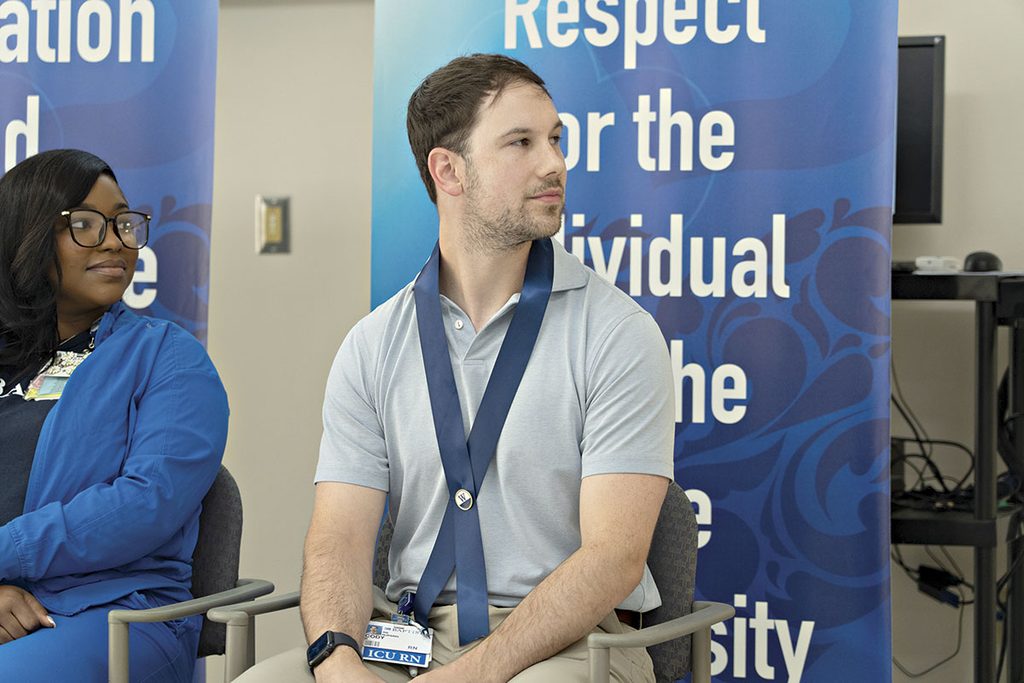
Five years ago, Cody Bolton graduated from Mississippi University for Women’s associate nursing degree program, well prepared to step into his career thanks in part to the help of clinical instructors who helped him find his footing.
Bolton now hopes to have the same impact as one of six Baptist Memorial Hospital-Golden Triangle nurses to be certified in September as clinical coaches in a partnership between the hospital and university designed to address the state’s nurse shortage from the inside out.
“I had really good preceptors that helped me a lot whenever I was starting out, and I feel very strongly about helping people be fully prepared and feel fully comfortable because I know what it feels like sometimes to lack confidence … whenever you’re going out on your own,” said Bolton, who also earned his Bachelor of Science in Nursing degree from The W in 2022. “Even just teaching them small tricks that help them feel like they’re more efficient … in what they’re doing, I take a lot of pride in that.”
The clinical coaches are tasked with serving as mentors to MUW student nurses in the Mississippi Clinical Advancement and Residency Experience, which aims to strengthen the connection between education and clinical experience by allowing students to complete a portion of their required clinical hours in the hospital, paired one-on-one with an experienced nurse.
Baptist is the second hospital in Mississippi to partner with a university for a clinical coach program.
Students in the program are also paid a stipend throughout the apprenticeship, and after graduating, they sign on for a yearlong contract with Baptist.
For nursing students like Jonathan Morales, who is set to graduate in May 2027, that preparation is invaluable. While he already has experience working as a licensed practical nurse, working with a Baptist clinical coach ensures he’s already familiar with the day-to-day operations at the hospital once he signs his one-year contract.
“You already know that software,” he said. “You know what to do, what the rules are – the protocols. So once we’re done with school, we’re there for a year, and then we don’t have to ask as much questions to somebody that’s training us.”
To become a clinical coach, Baptist nurses complete a two-course certificate program at The W designed to help nurses develop their coaching methods. Bolton said the course helped him translate the informal mentoring he already does with new nurses in his unit into a more deliberate coaching method to apply with his assigned students.
“It (teaches you) how to evaluate students and how to work with them to figure out what (are) some little things that you can do during the shift … that can help,” he said. “You figure out the best way they learn, the best way to give them positive feedback without tearing them down – things like that.”
Once paired with a coach, students essentially shadow the nurses throughout their shifts while also earning some hands-on practice working with patients. Morales said it’s a different relationship than students might have with a traditional clinical instructor.
“With a clinical instructor, in a student’s mind, they don’t want to sound unprepared,” Morales said. “With a clinical coach, you know that person, or you’re getting to know the person, and it’s just building a relationship. You work with them for the whole 10 or 12 hours, so everything that they do, we are also experiencing that with them.”
Morales said that relationship also helps build confidence. He felt that most while working in the pediatrics unit. With little pediatrics experience, he said it was a nerve-wracking clinical to prepare for.
“However, when I was with my clinical coach in peds, it was calming. It was more, ‘This is how we do it. This is what you’re going to expect,’” he said. “… There were times (when) I wasn’t confident, but that’s why the clinical coaches are there, to basically help you in developing your courage in practicing that one-on-one with the patient.”
Words By EMMA MCRAE
Photos by CHRIS JENKINS