
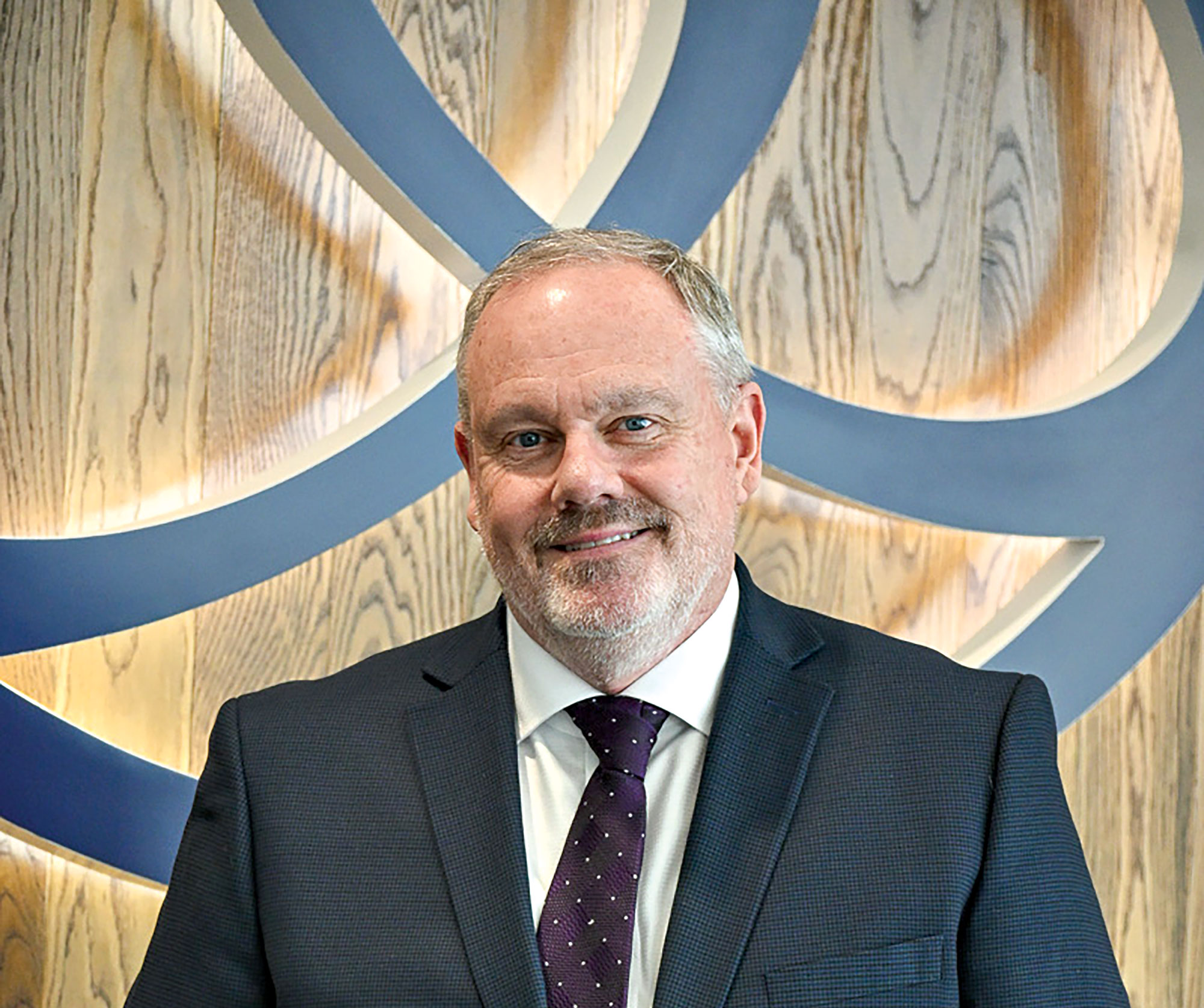
Named the new CEO for Golden Triangle Development LINK in February, Iain Vasey brings more than 30 years of economic development experience in Texas, Louisiana and most recently Oregon, helping recruit almost $60 billion in capital investment over that span.
From landing one of the nation’s largest economic development deals in Texas to creating military construction cooperative agreements to boost city revenues and championing housing initiatives in Oregon, Vasey’s experience lies in data-driven, long-term economic strategy and large-scale project execution.
News editor Emma McRae spoke to Vasey in March to discuss some of his passions within economic development, his past experiences and how the two will come into play for the Golden Triangle in his new role.
Housing is a big conversation here right now. How do you see that playing out in the Golden Triangle?
It’s a passion of mine because I think housing is an important economic factor that not enough that not enough economic development organizations pay attention to. Think about it this way: if you land a factory that has 300 or 400 employees, where are you going to house those employees?
I have to delve into the details and the data, and I don’t have my arms around it yet. But when you think about it, there are two factors at play. One is the affordability index. So the first one of those is, can a family making $60,000-$80,000 a year using traditional financing mechanisms … be able to afford $240,000-$250,000, or are there no houses at that price point? Are they all $300,000-$350,000? Then you’ve got an affordability index. Then you look at the availability index. … Is it a seller’s market or is it a buyer’s market? You kind of want a little bit of equilibrium between them.
I’m just realizing, I sound like the biggest nerd ever. My history and background is in economics. So I try to understand, what are the economic factors? I read every economic paper I can get my hands on to be able to understand that.
Both with housing and the military construction cooperative agreements, you seem like someone who is looking for solutions that might be out of the box.
My job is to think not about today’s challenges and today’s problems. It’s to start thinking ahead five years down the line, because the solutions you come up with today are going to be implemented and going to take several years to put in place. You know, you can’t just go, ‘Oh, we’re going to have a housing policy and all of a sudden, 500 houses show up the next day. It doesn’t happen.
There’s a saying I kind of follow… you know who Wayne Gretzky is?
The hockey player?
Yes, he was famous for saying, ‘Don’t skate to where the puck is. Skate to where it’s going to be.’ So you have to think ahead. There are a lot of people dealing with the today problem. How do you deal with this today? But then there are other folks that say, ‘How do you position your economy and your economic development strategy and all of your policies that tie into that, how do you put them in place five years ahead, so that five years from now, you’re in a very strong position?’ Nothing happens instantaneously.
Like, a Megasite isn’t built in a day?
Right, that Megasite took a lot of time, investment and planning by a lot of folks. Now we’re at the point of, can we execute? That said, you watch what’s going on in today’s economy. … In old fashioned terms of economics, two consecutive negative quarters is a recession, right? So you look at what’s happened, and you never truly know you’re in a recession until it’s in your rearview mirror.
You look at the numbers, like the revised job count numbers from last month is, I think we lost 90,000 jobs nationwide, the amount of investment that’s going on.
Since about 1995, when the numbers started really being tracked across the entirety of the South, the biggest (three) categories for major investment economic development deals are in either automotive and related … aviation and financial services, and there hasn’t been a year compared to 2025 in decades of the lack of performance and uncertainty in the market. And there are, there are deals, but they’ve been primarily in things like data centers.
It’s clear you have to be judicious in a lot of different areas when you’re making economic development deals.
You have to be rational, and you have to do a lot of analytics. … When somebody asks, ‘Well what do you bring to the table?’ At the end of the day, a company might know who I am. A site selection consultant may know who I am, knows that you’re a straight shooter or not. They may take a meeting because they know who I am. But at the end of the day, the company won’t make a positive decision based on any individual. It’s all down to the analytics =, those labor costs, utility costs, your availability or water and sewer and power and rail and all the other factors.
It all comes down to Moneyball economic development. Do you have the data? And the accuracy of the data has to be unimpeachable. There are economic development people in this universe that will shade the truth, not quite honest. At the end of the day, you don’t operate like that. Companies are smart. They have very smart people. They will figure it out if you are not being straight, and you have to be absolutely straight up. And if you’ve got a challenge, if you’ve got a weakness, admit the weakness and understand how you’re going to address it and build towards removing that weakness and turning it into a strength.
What do you see as your responsibility when it comes to working on the community side of the job?
My job is to, at the moment, I have to translate being just a name and a photograph or something on a piece of paper, to this is a person who has background and skills and knowledge and experience in the industry and credibility. … We don’t play favorites within (the municipalities), there are three counties and multiple cities. We don’t steer deals. The client tells you where the client wants to go.
Story and Photo by Emma McRae